
Wirt Scheduled and Actual Release
A projected release date is a calculation, not an exit record. WVDCR policy uses terms such as projected minimum discharge date and Minimum Discharge Date or Final Release Date in sentence-computation records. The date assumes continued incarceration under the calculation then in effect. An actual release has occurred only when the person leaves that specific custody through discharge, parole, transfer, or another lawful route.
A Wirt defendant held before trial usually has no computed sentence-expiration date. Bond, dismissal, a court order, and any other hold determine the legal path. Processing and transport can affect the physical departure time. By contrast, a sentenced state prisoner may have a projected date based on the term, credited jail time, and statutory good time.
A roster disappearance proves neither event. The person may have moved from NCRJCF to a state prison, another jail, USMS, or ICE custody. The official release or transfer field resolves that ambiguity.
Find Wirt Projected Release Dates
Choose the system from the sentence, not merely from the person's tie to Wirt County. NCRJCF is the regional jail serving Wirt. The prison side of WVDCR's Offender Information System applies after a state-prison commitment. A federal sentence belongs in the federal system, and a pretrial Wirt case remains tied to the court and regional-jail record.
Follow a record trail that preserves each field as published:
- Confirm identity with the full name, birth date, OID, case number, and committing county when available.
- Use the WVDCR offender-search landing page. Select prison search for a sentenced state prisoner or jail search for a regional-jail detainee.
- Open the matching detail. Copy the date label exactly, along with the value, facility, status, and access date.
- Read the Wirt court case for the sentence, amendments, jail credit, bond, or release order. Search magistrate and circuit records as the case requires.
- For precision, request the current time sheet, projected minimum date, mandatory date, full-term date, and any discharge certificate from WVDCR.
- Near the date, register for a custody alert and confirm the final event with the reporting facility.
The Wirt County released-inmate record path covers the court, jail, prison, and formal-record channels in more detail. If the public prison search no longer returns a discharged person, request the historical fields rather than assuming the record never existed.
WVDCR Fields for Wirt Releases
Official materials identify a public field called projected release date. WVDCR policy adds more exact sentence-computation terms. Public search behavior for fully discharged people was not verified as permanent, so the formal offender record is the safer source for a past Wirt County release.
| Field | What it can establish |
|---|---|
| Projected release date | A forecast shown in the public prison record, subject to the WVDCR disclaimer |
| Projected minimum discharge | A policy-record calculation based on sentence and current credit |
| Full-term expiration | The sentence endpoint before applicable release mechanisms are interpreted |
| Mandatory release date | A supervision-linked date where the statute and sentence make it applicable |
| Good-time allowance and rate | Credit applied within the official computation |
| Jail-credit time | Presentence custody credited by the sentencing court |
| Release date and time | The completed custodial event, when recorded |
| Method and destination | Whether the event was discharge, parole, or transfer to another authority |
Ask for exact fields instead of “all records.” A specific request is easier to route and less likely to mix a forecast with the physical release event.
For a formal WVDCR request, include the full name and aliases, date of birth or OID, Wirt as the committing or sentencing county, the approximate booking range, NCRJCF, and the case number if known. Request the current time sheet, projected minimum date, mandatory date, full-term date, jail credit, good-time entries, release date and time, discharge method, destination, and discharge certificate. Policy Directive 142.00 calls for a written, reasonably specific request. It lists paper copies at $0.15 per one-sided page plus postage, prepaid, while electronic delivery may avoid those paper costs.
Note: WVDCR warns that public status, location, and release-date information can change quickly and may be inaccurate.
West Virginia Good Time
West Virginia Code §15A-4-17 provides one day of good time for each day an eligible adult DCR inmate is physically incarcerated. Credited presentence jail time can count when the sentencing court awards it. Credit is deducted from the maximum of an indeterminate sentence or the fixed determinate term. Life sentences receive no good time, and consecutive terms are aggregated.
The statute screenshot below comes from the official West Virginia Legislature good-time page.
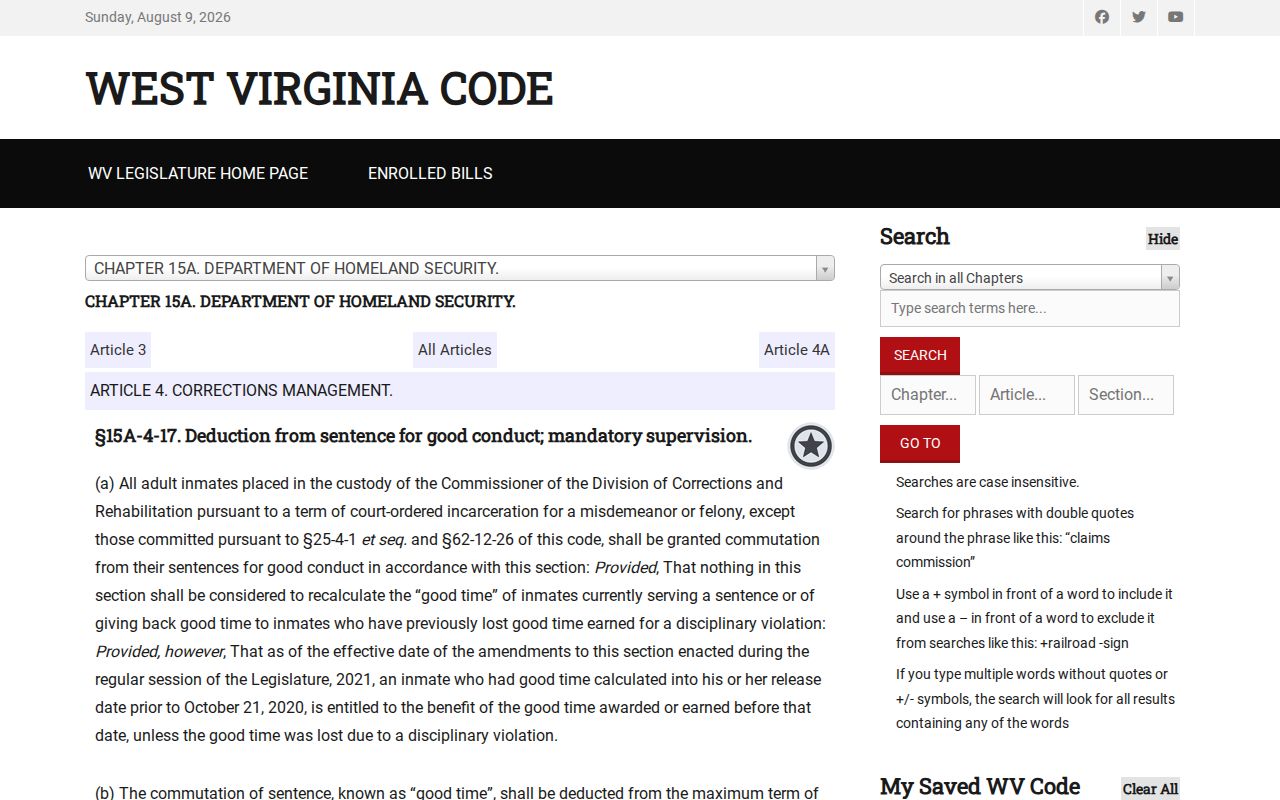
No credit accrues while a person is on parole, bond, or other time outside physical incarceration. Discipline can cause forfeiture. The commissioner may approve restoration. WVDCR must revise its sentence statement when a loss or restoration changes the earliest discharge. Extra credit may also be available for qualifying service or approved nonrequired education and vocational programs, within the statutory limits.
The one-for-one rule can produce a rough result near half of an eligible uninterrupted maximum or fixed term, but that illustration should never be applied to a named person. The legal sentence may have a controlling minimum, excluded credit, multiple terms, or a supervision carve-out. The official calculation also incorporates the court's jail-credit award. Only the current WVDCR time sheet can show how those parts were entered for the individual case.
Wirt Release Dates Reject 85 Percent
No general West Virginia rule requiring every state prisoner to serve 85 percent of a term was verified. That shorthand often comes from a different system. West Virginia's general statute uses one-for-one good time for eligible physically incarcerated adults. Offense rules, minimum terms, credit exclusions, and consecutive sentences can change the result. A homemade percentage is not a safe substitute for the WVDCR time sheet.
For specified violent-person, minor-victim, and firearm felonies committed on or after the controlling statutory date, one year of accumulated good time can become one year of mandatory post-release supervision with electronic monitoring. Other felony cases may include a shorter court-ordered supervised period under the same statute. This is a release from physical custody into supervision, not the end of the sentence.
Policy Directive 151.06 defines the Minimum Discharge Date or Final Release Date as the scheduled release if custody remains continuous and no good time is lost. Its assumptions make the official calculation more reliable than counting days from a judgment.
What Changes Wirt Release Dates
A projected date can move in either direction. The public search may not show every cause. Court orders, internal time sheets, supervision records, and receiving-custody records fill those gaps.
| Factor | Effect on the projected or actual event |
|---|---|
| Corrected jail credit | Changes the credited starting balance used in the sentence computation |
| Good-time loss or restoration | Moves the minimum discharge date as discipline or approved restoration is entered |
| Consecutive sentences | Aggregates terms and may extend the controlling end point |
| Sentence amendment | Changes the legal term or credits through a later court order |
| Parole decision | A grant may permit earlier community supervision; denial or deferment leaves custody in place |
| Detainer or warrant | May send the person to another authority instead of the community |
| Release processing | Can separate the legal authorization from the recorded physical departure time |
Parole eligibility is also distinct. Under §62-12-13, general eligibility can begin at the minimum of an indeterminate term or one-fourth of a definite term, subject to other rules. Section 62-12-13a says eligibility does not create a right to release. The Board can deny or defer.
Wirt Jail Release Dates Differ
A person held at NCRJCF on a Wirt matter may be a pretrial detainee, a county-sentenced inmate, a person awaiting state-prison transfer, or someone held for another authority. Do not apply a prison projected-date field to each case. For a pretrial detainee, the court controls bond and release authority. The facility record shows whether and when the person left.
Ask NCRJCF or WVDCR records for the booking and departure date and time, method of discharge, destination, authority or order number, sentence, and jail credit. Then compare those fields with the Wirt magistrate or circuit docket. A bond entry proves legal authority only after the terms are met. Another warrant, detainer, or pending case can block community release.
No official NCRJCF release hour, weekend rule, exit point, or public schedule was found. Call the facility at 304-873-1384 for current instructions and do not infer an hour from the date alone.
Note: The regional jail serves eight counties, so match Wirt as the committing county before relying on a result.
Confirm Wirt Release Events
Near a scheduled date, use the Wirt County VINELink check to register for a custody-change notice. West Virginia VINE may report a release or transfer event from the reporting agency, but transfer notifications can be delayed until arrival. Save the event label, facility, and time shown.
Next, call the facility or request the release record. Ask what the event meant: community release, parole, mandatory supervision, full discharge, or transfer. For a state-prison term, the current time sheet and discharge certificate carry more weight than a prior search capture. For a Wirt regional-jail booking, the departure record and court order should agree on the authority and outcome.
Federal custody remains separate. The BOP locator may show a release date for a sentenced federal prisoner, but federal credit rules do not control a West Virginia sentence. A federal pretrial detainee at NCRJCF may remain a USMS and federal-court matter instead of appearing as a normal BOP case.
Keep a small verification log. Note the field name, value, system, access date, and staff office contacted. After the person leaves, replace the forecast with the actual departure record. If the records conflict, ask the custodian whether a later court order, credit correction, lost or restored good time, parole action, or receiving hold explains the change. That preserves a clear line between what was once projected and what finally occurred.